
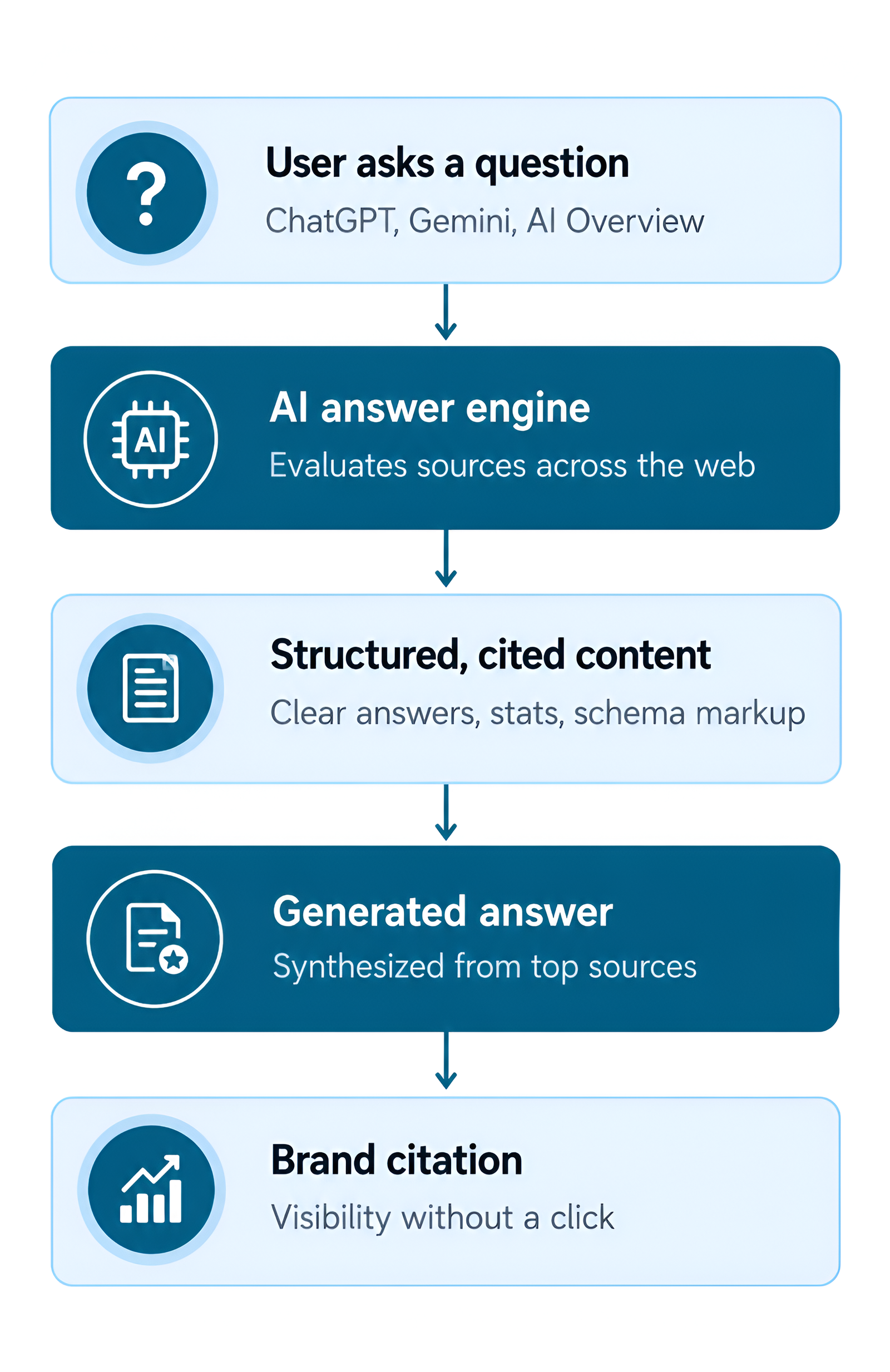
Search has split into two tracks. One is the familiar list of blue links. The other is a single, synthesized answer generated by ChatGPT, Google AI Overviews, Perplexity, or Copilot -that a user reads without ever clicking through to a website. Answer Engine Optimization (AEO) is the discipline built around that second track: making sure your brand is the source these AI systems choose to cite.
This guide covers what AEO actually is, the market trends and data behind why it matters right now, what a real AEO strategy looks like, and how to start improving yours.
What Is Answer Engine Optimization (AEO)?
Answer Engine Optimization is the practice of structuring content, technical infrastructure, and site architecture to maximize visibility in AI-powered answer engines -platforms like ChatGPT, Google AI Overviews, Google AI Mode, Perplexity, and Microsoft Copilot. Where traditional SEO optimizes a page to rank in search engine results pages, AEO optimizes content so it can be retrieved, verified, and directly cited inside an AI-generated answer. As one 2026 industry guide puts it, the goal of AEO isn’t just to rank -it’s to be the source an AI system quotes when it composes a response.
This isn’t a rebrand of SEO. It’s an additional, increasingly necessary layer, because the two environments reward different things: SEO rewards keyword relevance and backlinks; AEO rewards clear structure, verifiable statistics, and content that’s genuinely easy for a model to extract and quote.
Why AEO Matters Now: The Market Trends and Numbers
The shift toward answer engines isn’t a prediction anymore -it’s measurable, and it’s accelerating fast.
- According to Gartner’s 2026 search forecast, 25% of all search interactions will use AI-generated answers by the end of 2026, rising to 50% by 2028.
- Zero-click search has become the norm Similarweb data shows zero-click search rates have risen from 56% to 69% since AI Overviews launched, and SparkToro research found that 68.01% of U.S. Google searches in the first four months of 2026 ended without a click. This makes strong Technical SEO, structured content, and AI-search visibility increasingly important for maintaining organic presence.
- Seer Interactive’s analysis of over 3,100 informational queries found that when AI Overviews appear, organic click-through rate dropped 61% for brands not cited in the Overview but for brands that were cited, the same queries drove 35% more organic clicks and 91% more paid clicks compared to non-cited competitors.
- Forrester reports that 89% of B2B buyers have adopted generative AI as a central source for self-directed research, and G2’s 2026 “Answer Economy” report found 51% of B2B software buyers now start research in an AI chatbot, up from 29% in April 2025. This highlights the need to combine Technical SEO, AEO, and AIO so content can be effectively crawled, understood, retrieved, and cited by search engines and AI platforms.
- Coherent Market Insights projects the global AEO platform market will grow from USD 665 million in 2026 to USD 953 million by 2033; a separate analysis projects the broader AEO market reaching USD 4.1 billion by 2035, a 43.4% CAGR.
- RevvGrowth’s 2026 analysis found early AEO adopters capture 3.4 times more AI visibility than late adopters. A strong foundation of Technical SEO, structured data, crawlability, content optimization, and entity signals can help brands build that visibility before competitors gain an advantage.
What Is an AEO Strategy?
A real AEO strategy isn’t a single tactic it’s a coordinated approach across content, technical structure, authority building, and measurement, typically built around four pillars:
- Content structured for extraction: Content specifically formatted for LLM extraction clear headers, direct answers, concise paragraphs is 3 times more likely to be cited than unstructured equivalents.
- Evidence and sourcing: AI engines favor content that backs claims with real statistics and named sources. Supporting this with a strong Link Building Solution can also strengthen website authority and reinforce the credibility signals that search engines and AI platforms use when evaluating content.
- Technical trust signals: Sequential, logical heading structures increase citation odds by 2.8 times, and rich schema markup further increases citation likelihood. Technical SEO should work alongside a Link Building Solution to build both technical accessibility and external authority.
- First-party data: Original business benchmarks and customer outcomes earn brand-specific citations that third-party statistics cannot, because AI engines cite the original source of the data.
A strategy also has to account for which platform you’re optimizing for. A 2026 NJIT study (presented at SIGIR) analyzing over 14,000 queries across Google Search, AI Overviews, and Gemini found that the sources each engine retrieves overlap very little meaning a page cited by one AI platform can be completely absent from another’s answers. This makes a coordinated approach combining AEO, Technical SEO, content optimization, and Link Building Solution essential for building broader search and AI visibility.
How Answer Engines Decide What to Cite
Citation behavior differs meaningfully by platform. A 2026 study by xfunnel.ai, analyzing 40,000 AI answers across major models, found Perplexity cites an average of about 6.6 sources per answer, Google Gemini around 6.1, and ChatGPT a leaner 2.6 meaning the bar for being one of the few sources ChatGPT actually cites is considerably higher than for Perplexity.
Authority also plays a measurable role: there’s a 0.65 linear correlation between a website’s domain authority and how often it’s cited by AI systems. This makes Content Marketing an important part of an AEO strategy, helping brands consistently publish authoritative, evidence-based content that can earn mentions, links, and citations across search and AI platforms.
Third-party platforms matter too: nearly 48% of ChatGPT referral citations come from Wikipedia, and Reddit appears in roughly 21% of Google AI Overview citations underscoring that off-site presence, Content Marketing, and brand mentions elsewhere on the web can feed directly into AI visibility.
What Are the Best AI Search Visibility Tools?
As AEO has matured into a measurable discipline, a dedicated category of tracking and optimization platforms has emerged specifically to monitor brand visibility inside AI answers:
- Profound, BrightEdge, Semrush, and Otterly AI are named among the key players actively shaping the AEO platform market as it scales toward nearly $1 billion by 2033.
- xfunnel.ai specializes in large-scale citation analysis across ChatGPT, Perplexity, and Gemini.
- Most of these tools track the same core metrics: citation rate (how often you’re mentioned), share of voice (how you compare to competitors), and sentiment (how positively your brand is described). Alongside these measurements, SMM (Social Media Marketing) can strengthen brand visibility across social platforms, increase online mentions, and support the broader signals that contribute to AI search visibility.
Choosing a tool matters less than choosing to measure at all on average, only 30% of brands stay visible from one AI answer to the next, which makes continuous tracking, AEO, and SMM essential rather than a nice-to-have.
How Do I Improve My AEO?
Based on current AEO research, these are the highest-leverage, most consistently cited tactics:
1. Answer the exact question in the first sentence or two. AI engines extract short, self-contained statements far more reliably than long, meandering paragraphs.
2. Back every claim with real, attributed data. Statistics with named sources are among the most consistently cited content types.
3. Use sequential, logical heading structures. This alone lifts citation odds by 2.8x.
4. Add schema markup, particularly FAQPage and Article schema, to give AI crawlers a direct, structured signal.
5. Publish original, first-party data. Benchmarks and proprietary research earn citations that recycled stats cannot.
6. Build brand mentions off-site, not just on your own domain.
7. Track performance by platform, not as one number, since citation sources barely overlap between engines.
8. Treat AEO as continuous, not a one-time project. With only 30% of brands retaining visibility between answers, ongoing monitoring matters.
What AEO Specialists Are Saying
The people doing this work day-to-day are candid about where the discipline stands. Lily Ray, VP of SEO Strategy at Amsive Digital, has noted that AEO measurement is still in its infancy -a reminder that even as tactics mature, the analytics tooling to prove ROI is still catching up.
On the buyer-quality side, Amanda Sellers, SEO & AEO Strategist at HubSpot, has observed that buyers arriving from AI answer engines tend to be much more qualified by the time they land on a page -which tracks with HubSpot’s own reported data showing AEO-driven leads converting 3 times higher than leads from other sources.
Common AEO Mistakes to Avoid
- Treating AEO as a rebrand of SEO instead of a distinct discipline with its own citation mechanics
- Measuring only Google AI Overviews while ignoring ChatGPT, Perplexity, and Gemini
- Publishing claims without attribution, which reduces trust and citation likelihood
- Skipping schema markup, leaving an easy, high-leverage technical signal on the table
- Treating AEO as a one-time project rather than an ongoing measurement and content-refresh cycle
Why Work With an AEO Agency
Implementing all of this correctly platform-specific citation tracking, schema architecture, first-party data strategy, and content restructured for extraction is a meaningfully different skill set than traditional SEO execution. An experienced AEO agency or SEO Expert USA brings the tooling and platform-specific expertise to diagnose where your brand is (and isn’t) being cited, and to close that gap systematically rather than by guesswork.
If your brand isn’t currently showing up when ChatGPT, Gemini, or Google’s AI Overview answers questions in your category, that’s a visibility gap actively costing you qualified traffic exactly the kind of gap experienced AEO experts are built to close. Contact us today to strengthen your brand’s visibility across AI-powered search experiences.
