
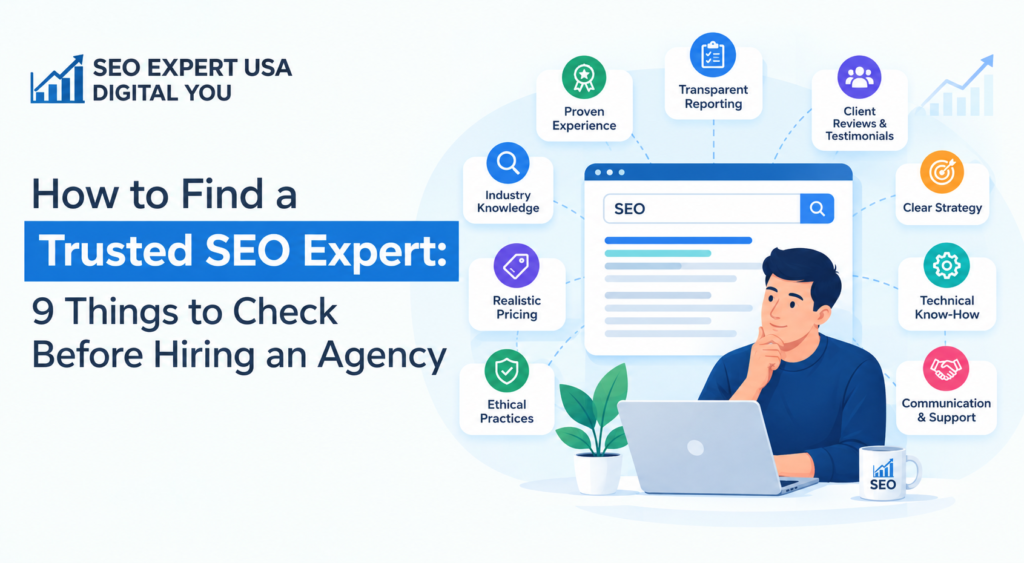
Searching “who is the best SEO expert” or “who is the most trusted SEO expert” gets you long lists, bold claims, and very little proof. The better question is how to verify any SEO expert before you give them access to your website and your budget.
This guide covers where to find SEO experts, nine checks to run before hiring, and the warning signs of an unreliable provider. It leans on Google’s own hiring guidance, Google’s spam policies, and 2026 pricing and local search data.
Who Is the Best SEO Expert in the USA?
There is no official ranking or certification that names one best SEO expert in the USA, and the best choice depends on your goals, industry, location, and budget. A national ecommerce brand, a local dentist, and a SaaS startup need different skills.
Well-known names in the industry are useful for learning, but fame doesn’t tell you who will do the work on your site or how they handle a client like you. Treat anyone who claims to be “the best” or “Google approved” with caution. Google advises being wary of tools or providers that claim to be “acceptable” or “approved” by Google Search.
Who is the most trusted SEO expert?
The most trusted SEO expert is one whose claims you can verify: named clients you can contact, outcomes tied to your business goals, transparent methods, and compliance with Google’s rules. The nine checks below turn “trusted” into something you can test.
Where Can I Find the Best SEO Experts?
Start with sources that give you evidence, then verify everything.
- Referrals from business owners you trust. One 2026 guide calls a direct recommendation from a peer who got real results the most reliable source. Ask what they paid, what changed, and whether they’d hire again.
- Verified review directories. Clutch says it verifies a provider’s business registration, legal history, credit background, and client feedback, and that its reviews go through human-led verification. UpCity and GoodFirms are similar. Know the limits: Clutch’s “Featured Providers” are paid listings, and UpCity also has paid placement.
- Read reviews carefully. The median rating on major directories is around 4.9 stars, and agencies choose which clients get interviewed, so treat reviews as a filter that removes bad providers, not a ranking that picks the best.
- Google search and Google Business Profile reviews. Good for volume and recency, but profiles can be padded.
- Professional communities. Google points to Search Console, the Search Central blog, and its help forum as free resources. They won’t pick a provider for you, but they teach you to spot bad advice.
- Local business networks if you need local SEO experts (see below).
9 Things to Check Before Hiring an SEO Expert
- Verify their case studies
Google suggests asking an SEO to show examples of previous work and share success stories. Then check them:
- Ask for the client’s name, website, date range, goals, and what was actually done.
- Ask for Search Console data (clicks, impressions, queries) with date ranges, not only rank-tracker screenshots.
- Look for business outcomes: leads, calls, bookings, revenue. Rankings alone can mean keywords nobody searches.
- Ask what else changed during that period, such as a redesign, ad spend, PR, or seasonality.
- Use the Wayback Machine to see how the site changed over time.
- Check that the client’s site and industry resemble yours.
- Call references
Google advises asking past clients whether the SEO provided useful service, was easy to work with, and produced positive results. Ask references:
- What exactly did they do each month?
- How quickly did they respond and report?
- Were there surprises in cost or scope?
- Did results continue after the engagement?
- Would you hire them again?
- Check that their promises are realistic
Google says an SEO audit should give realistic estimates of improvement and the work involved, and that if someone guarantees first place in search results, you should find someone else. Honest providers give ranges, assumptions, and timeframes. Agencies commonly cite 3 to 6 months before local SEO shows measurable improvement.
Good questions:
- What results do you expect, in what timeframe, and how will we measure them?
- What would make you revise that estimate?
- Demand clear reporting and account ownership
Google recommends asking whether your SEO will share every change they make to your site and the reasoning behind their recommendations. A solid monthly report includes:
- Search Console clicks, impressions, top queries, and top pages
- Analytics conversions (calls, forms, sales)
- Google Business Profile actions, for local businesses
- A log of work completed and what’s planned next
- A list of links earned, with source and why it was chosen
You should own your accounts (Search Console, Analytics, Business Profile, hosting). For an audit, Google advises granting only read access to Search Console and no write access at that stage. Be careful if a provider is secretive or won’t clearly explain what they intend to do.
- Test their technical skills
Ask them to walk through how they’d audit your site. Google lists technical advice such as hosting, redirects, error pages, and JavaScript among the services SEOs provide. Check whether they can explain:
- Crawling and indexing problems, and how they’d find them
- Redirects, canonicals, and duplicate content
- Core Web Vitals and site speed
- JavaScript rendering issues
- How they’d diagnose a sudden traffic drop (Google publishes a guide to debugging traffic drop)
Good signs: they cite official Google documentation as supporting evidence for their recommendations.
- Ask how they build links
This is the answer to “who is the best link building expert?” There isn’t a single name. What matters is the method. Google’s link spam examples include exchanging money or goods for links, excessive link exchanges, automated link creation, advertorials with keyword-rich anchor text, and low-quality directory or bookmark links. Paid and sponsored links aren’t a violation if they’re qualified with rel=”nofollow” or rel=”sponsored”.
Ask:
- Where will the links come from, and can I see examples?
- Are they editorial, earned, or paid? How are paid links qualified?
- Do you use private blog networks, bulk directories, or tiered link layers?
Layered or “tiered” link schemes and bulk directory submissions usually rely on automated or low-quality links, which fall under what Google describes as link spam. Google also says you should never have to link to your SEO, and to avoid link popularity schemes.
- Check that their advice matches Google’s guidance, including on AI search
Ask whether they follow the Google Search Essentials. Google revised its hiring guide on June 5, 2026 to add warnings about ranking guarantees, unverified third-party tools, and AEO and GEO claims. Google suggests asking whether AEO or GEO advice lines up with its official guidance on generative AI features, and whether the provider uses tools aligned with Google’s guidance.
Third-party tools don’t have access to Google’s internal ranking data. A tool score isn’t proof of anything.
- Match industry and location experience
Google lists experience in your industry, your country or city, and international markets among the questions to ask. A provider who has ranked a roofing company in another state may not understand your regulated or local market. Ask for work in your industry, and for examples in cities like yours.
- Review pricing, contract, and exit terms
Price alone doesn’t prove quality, but it helps spot outliers. The same Ahrefs survey reports average retainers of about $3,209 for agencies and $1,349 for freelancers. Local SEO retainers average about $1,557 a month. SE Ranking’s survey of 260 agencies found the most common retainer was $500 to $1,000 a month.
When comparing packages, count the work, not the plan name, since two packages at the same price can include very different things. Check:
- Exactly which deliverables you get each month
- Contract length and how to cancel
- Who owns content, links, and accounts if you leave
- What’s billed extra
How Do I Find Local SEO Experts?
Look for providers who run local campaigns for businesses like yours and can show local proof. The stakes are real:
- Bright Local’s 2026 survey found 97% of consumers read online reviews for local businesses, and 47% won’t use a business with fewer than 20 reviews.
- Whitespark’s 2026 expert survey found Google Business Profile signals make up about 32% of map pack ranking weight, the biggest single group.
- Google says a complete Business Profile makes customers 2.7 times more likely to see a business as reputable and 70% more likely to visit, yet only 35% of small businesses have one.
A good local SEO expert should:
- Optimize and manage your website and ask real customers for honest reviews, never buy or fake them
- Keep your name, address, and phone consistent across listings
- Build genuinely useful location pages. Google treats pages created to funnel visitors from multiple cities into one page as doorway abuse.
- Report on calls, direction requests, and form fills, not just rankings
Are There SEO Firms That Specialize in Structured Content for Answer Engines?
Yes. Many agencies on Clutch now pair traditional SEO with generative engine optimization (GEO) and answer engine optimization. The service is real, but the claims need checking.
- Know which platform they mean. Google says generative AI features in its Search are built on core Search ranking systems, so optimizing for them is still SEO. ChatGPT, Perplexity, and other platforms work differently, and Google’s guidance doesn’t cover them.
- Be skeptical of “special” tactics for Google. Google says you don’t need LLMS.txt files or special markup, don’t need to chunk content into tiny pieces, don’t need to rewrite content just for AI, and aren’t helped by seeking inauthentic mentions.
- Structured data isn’t a magic switch. Google says it isn’t required for generative AI search and there’s no special schema.org markup to add, though it still helps with rich results.
- Ask how they measure. Google offers a Generative AI performance report in Search Console to see how your content performs in its AI features. For other platforms, ask how they test prompts and how often.
- Prefer substance. Google says unique, non-commodity content likely influences presence in generative AI search more than anything else in its guide.
Questions to Ask on the First Call
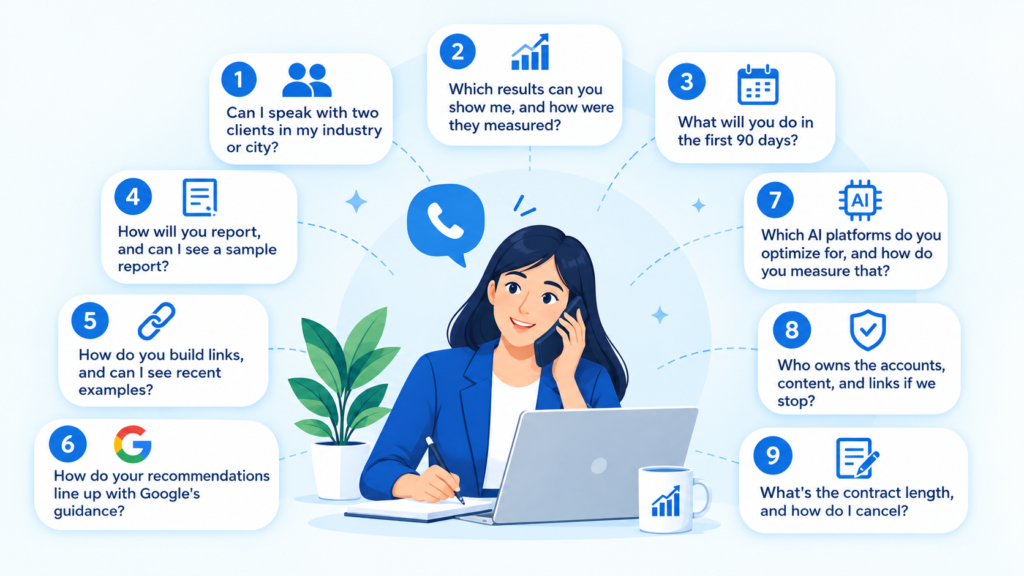
- Can I speak with two clients in my industry or city?
- Which results can you show me, and how were they measured?
- What will you do in the first 90 days?
- How will you report, and can I see a sample report?
- How do you build links, and can I see recent examples?
- How do your recommendations line up with Google’s guidance?
- Which AI platforms do you optimize for, and how do you measure that?
- Who owns the accounts, content, and links if we stop?
- What’s the contract length, and how do I cancel?
Apply These Checks to Every Provider, Including Us
Use this checklist on everyone on your shortlist. SEO Expert USA lists SEO, local SEO and Google Business Profile, technical SEO, link building, content marketing, answer engine and generative engine optimization services, with monthly reporting and hourly, monthly, or fixed-fee hiring options. Hold us to the same standard as anyone else: ask for references, sample reports, and a plain explanation of methods.
